Tuesday, March 15, 2016

6 Wrong Ways to Write About Horses

Column by Vicki L. Weevilauthor of FACSIMILE (March 8, 2016, 
Month9Books). Weavil turned her early obsession with reading into a 
career as a librarian. After obtaining a B.A. in Theatre from the University 
of Virginia, she continued her education by receiving a Masters in Library 
Science and a M.A. in Liberal Studies. She is currently the Library 
Director for a performing and visual arts university. Follow her on Twitter
I saw a promo for the film, THE REVENANT, the other day and glimpsed a scene where a horse and rider sail off a cliff. Yeah, it looks cool, but like many other ways horses are depicted in movies and books, it doesn’t ring true.  (I’ve already seen many people comment negatively on this scene in reviews, so I know I’m not the only one who doesn’t buy it).
Fortunately, many books and films display an understanding of horses and horsemanship. But occasionally a lack of knowledge or research rears its shaggy head. So, as someone with a background in this area, I’d like to mention a few common errors that make readers like me cringe.
1. Horses not being cooled down after exertion. Picture a romance novel, where a dashing hero must ride hell-for-leather to reach the church where his beloved is being married off to another. His horse is lathered in sweat. Sir Hero reaches the church, jumps off and … does nothing with the horse.
Any horse person knows this a big no-no. Hard-ridden horses must be walked until they are cool, because a hot horse given water or food can be permanently injured. Foundering, which can lame a horse, can be one result. If your character can’t take time to do this, please invent a stable urchin or someone to care for the horse!

Share/Bookmark

Scientists May Have Just Discovered a Parallel Universe Leaking Into Ours

We may have just, for the first time ever, caught a tantalizing glimpse of a parallel universe bumping against our own. Scientists say that signals from the furthest reaches of space suggest that the fabric of our universe is being disrupted by another universe. The discovery could provide proof of the multiverse theory, which says that there are many alternate universes.http://upriser.com/posts/scientists-may-have-just-discovered-a-parallel-universe-leaking-into-ours
Share/Bookmark

Study Finds That Psilocybin Creates A Hyperconnected Brain

Psilocybin, the entheogenic compound found within psychoactive mushrooms, is coveted for its ability to bestow imbibers with vivid hallucinations and unexplored avenues of thought. For millennia, psilocybin mushrooms have been used for spiritual purposes, with early evidence such the 6,000 year old cave paintings of mushrooms found in the Selva Pascuala cave, Spain, as well as Saharan cave paintings dated back to 7,000 BCE that depict ceremonial activity involving mushrooms, and much more.

TW_PsiloBrain01_670
It is no secret that psilocybin is capable of incredible psychiatric feats, but there remains much mystery as to how it performs said feats. Researchers have known for some time that the psilocybin compound binds itself to serotonin receptors in the mind, which are responsible for regulating appetite, mood, and sleep, though this understanding does not offer an explanation of the novel and indescribable experiences produced by psilocybin. In a past study, it was concluded that psilocybin decreased brain activity resulting in a sort of dreamlike state, but further research has found this to be only a partial explanation.https://www.sociedelic.com/study-finds-that-psilocybin-creates-a-hyperconnected-brain/

Share/Bookmark

Wednesday, March 9, 2016

Rock (Art) of Ages: Indonesian Cave Paintings Are 40,000 Years Old

Modern critics would probably hail the up and coming rock artists that once inhabited Indonesia. About a hundred caves outside Moras, a town in the tropical forests of Sulawesi, were once lined with hand stencils and vibrant murals of abstract pigs and dwarf buffalo. Today only fragments of the artwork remain, and the mysterious artists are long gone.


Read more: http://www.smithsonianmag.com/science-nature/rockart-ages-indonesian-cave-paintings-are-40000-years-old-180952970/#FkQ7gaK3PmaCRRSd.99
Give the gift of Smithsonian magazine for only $12! http://bit.ly/1cGUiGv
Follow us: @SmithsonianMag on TwitterFor now, all we know is when the caves were painted—or at least ballpark dates—and the finding suggests that the practice of lining cave walls with pictures of natural life was common 40,000 years ago. A study published today in Nature suggests that paintings in the Maros-Pangkep caves range from 17,400 to 39,900 years old, close to the age of similar artwork found on the walls of caves in Europe. 


Read more: http://www.smithsonianmag.com/science-nature/rockart-ages-indonesian-cave-paintings-are-40000-years-old-180952970/#FkQ7gaK3PmaCRRSd.99
Give the gift of Smithsonian magazine for only $12! http://bit.ly/1cGUiGv
Follow us: @SmithsonianMag on Twitter


Share/Bookmark

Sunday, March 6, 2016

High Neanderthal Ancestry in Ust’-Ishim Man

A large team of genetic scientists led by Dr Qiaomei Fu of Harvard Medical 
School has recovered and sequenced the DNA from a thighbone of a male 
hunter-gatherer who lived in what is now Siberia 45,000 years ago. 
... 
The sequence revealed that the bone came from an anatomically modern human, 
a man whose remains are the oldest ever found and carbon-dated outside of 
Africa and the Middle East. 

Comparison to diverse humans around the world today showed that the 
Ust’-Ishim man was a member of one of the most ancient non-African 
populations. 

“The ancient Siberian was related equally to West European hunter-gatherers, 
North Asian hunter-gatherers, East Asians, and the indigenous people of the 
Andaman Islands off South Asia,” said Dr Fu, who is the first author of a 
paper published in the journal Nature. 

“The fact that this population separated so early indicates that theories 
of an early split of people who followed a coastal route to Australia, New 
Guinea, and coastal Asia are not strongly supported by this data.” 
... 
The scientists also obtained a high-resolution estimate of the mutation 
rate in humans. 

Previous studies had given scientists evidence of two possible rates, one 
twice as fast as the other. Because of this large range, dates obtained 
from genetic research have tended to be quite uncertain. 

By measuring the number of mutations missing in the Ust’-Ishim man and 
comparing with people now, the scientists obtained an accurate estimate 
of the rate that mutations accumulated over time. They revealed a slower 
mutation rate, corresponding to between one to two mutations per genome 
per year. 
... 
“Instead of humans and Neanderthals becoming distinct offshoots sometime 
between 270,000 and 380,000 years ago, for example, the slower rate would 
put that shift much further back in time, between 550,000 and 770,000 
years ago.” 

“Similarly, the slower rate pushes back estimates for the date of the 
separation of African and non-African populations.” 

The slow mutation rates indicate that the present-day subdivisions among 
human populations date back to almost 200,000 years ago, well before the 
period around 50,000 years ago when the archaeological record documents 
art and new styles of tool-making. 
... 
The researchers also found that about 2.3 percent of the Ust’-Ishim man’s 
genome came from Neanderthals. 

The genomic segments of Neanderthal ancestry are substantially longer than 
those observed in present-day individuals, indicating that Neanderthal gene 
flow into the ancestors of this individual occurred 7,000-13,000 years 
before he lived (i.e. 58,000-52,000 years ago – a much tighter window than 
the previous range of between 37,000 and 86,000 years ago). 
... http://www.nature.com/nature/journal/v514/n7523/full/nature13810.html http://www.sci-news.com/genetics/science-genome-45000-year-old-siberian-man-02227.html
Share/Bookmark

Mysterious 'Population Y' May Have Bred with Amazonia Peoples

A number of natives of the Amazon rainforest may partly descend from peoples in the Pacific, researchers say.
It remains a mystery as to when and how this genetic signature from an Australasia group in the Pacific they call "Population Y" made its way to the Amazon, scientists added.
Most genetic studies have suggested that all Native Americans analyzedto date can trace much or all of their ancestry to a single common origin — a population from Eurasia that probably migrated to the Americas more than 15,000 years ago, back when lower sea levels exposed the Bering land bridge known as Beringia that connected the continents. Some Native Americans from North America and the Arctic may also trace other parts of their ancestry to more recent waves of migration.http://www.livescience.com/51618-mysterious-population-y-bred-with-amazonians.html

Share/Bookmark

Thursday, March 3, 2016

Update on the Bilbo Mound

For those of you following the Bilbo Mound story we covered in last week's post "Rain Goddess," we've just found a detailed report of excavations of the site in 2009 by the University of South Carolina.  It looks like the test pits were dug in the area directly to the South of the "temple."


There is fascinating information here.

Highlights:

* Discussion of "blue clay" ...Maya Blue/ Haint Blue connection anyone?

* Discussion of pile-driven houses in marshlands and estuaries circa 8000 - 10,000 B.C. in the "Discussion and Conclusion" sections.  This is classic Nusantao cultural behavior! The "Sea Gypsies" and "Sea Dayaks" of South-East Asia still practice pile driving midden culture today...you know those expert Sea-Farers with all the Microcephalin D and Y Haplogroup T?

*This culture used "Swamp Cane" like the Southeast Asians use bamboo in order to build walkways and dwellings over the middens. 

The paper also says that the Native Americans were storing the blue clay in pits lined with a ceramic for later trade, like rectangular coolers embedded in the middens.
The first episode of cable T.V.'s "America Unearthed" centered around Georgian polygorskite in Mexican "Maya Blue," as well as the mesoamerican terraces of N.E. Georgia and a Native American skeleton with an elongated skull in south-central Georgia. 


My main area of research has been the Upper Paleolithic and Mesolithic, and this site is of great interest to me because of its possible ties with the findings of Stephen Oppenheimer. In his book "Eden in the East" the doctor describes three phases of mass flooding at the end of the Younger Dryas prompting three separate waves of Nusantao cultural diffusion. 
He's already linked the SE Asian continent of Sundaland to Mesoamerican cultures and the world-wide distribution of the blowgun, fish poisons, bird shamans, dragon mythos, megaliths,the "two soul" religions, shell middens, bolas, agriculture, Frazer's corn god, and many other cultural traits shared by far-flung civilizations. 

Many fringe theorists have made speculative claims about the similarities between advanced "dawn"civilizations, but everything from the banana to the pig seems to have its genetic roots in South East Asia.
I think it's safe to add artificial cranial deformation (credit Paul Kekai Manansala), Microcephalin D, Y Haplogroup T, human sacrifice, headhunting, belief in "Ki," "Mana," or "Oro" energy, and some really large stone balls to certain  waves of Nusantao diffusion.


I can't find anything on the early use of bolas other than China, South America, and possibly Australia...but eastern neanderthal and homo erectus soloensis in Java used them before homo sapien ever did, and they were once called Ngangdog balls when found by archeologists in Java.
There's been a lot of hoopla about elongated skulls, and the main-stream scholars make it worse by their claim that the practice happened independently all over the world at roughly the same time with no central underlying cause whatever.
Obviously people didn't wake up all over the world's coastlines one day around 3,500 B.C. and say, "Hey! Let's warp our babies' heads today!"
Only a cloistered scientist without any street-smarts could propose such a notion. It requires a belief in a Universal Mind, Rupert Sheldrake's 'Morphic Field," or a particularly psychic and timely sort of cultural convergent evolution in order to even entertain the idea.

These people were obviously emulating something, and the practice obviously spread from one location to the coasts via a maritime culture.

The Teshik-Tash Neanderthals threw me off of the answer for quite some time, because scientists actually thought that they were practicing artificial cranial deformation 30 thousand years ago.  
Now we know that they were not practicing any form of head-binding at all; their heads actually grew that way naturally!
  
Come to think of it, homo erectus soloensis had a dolicephalic skull as well. The same ones who shared the neanderthal cultural trait of "Ngangdong Balls"... or Oppenheimer's Nusantao Bolas.

We know why mainstream scientists won't address these questions; "diffusion" is a dirty word when used to describe prehistoric cultures, even when it provides a common sense answer to a problem that needs and has an obvious answer.

But why are the "fringe scientists" looking for a source in little green men? We don't have the skeleton of a little green man... but we have the skeleton of a Shanidar Neanderthal.
We have the skulls of Nusantao priests and sailors. We find them wherever we find megaliths, Y Haplogroup T, high concentrations of Microcephalin D and ASPM D, as well as cranial deformation, non-tonal languages,and Denisovan introgression. 

And sure enough, cranial deformation is a practice known from the coastal areas of Georgia within the "Mesoamerican-influenced" early shell-ring cultures and related tribes in Florida.

Update:  The good news- Though there is a map of several vandal pits contained in the paper, the Bilbo Mound is at least 70% intact!  A barbed wire fence has been built around it, and pictures of the inside show that it is largely unaffected by the outer litter.  Good job, archeologists dudes!  I still think the outside should be cleaned up for pest control reasons, however.

Update II: Archeologists from Georgia Southern university have confirmed to me that though the culture of the Woodland and Archaic periods in the South-East was unlike any other in North America, there are other examples of stilt-house midden-dwellings in Florida's related Native American cultures.

Update III: The City of Savannah is now proposing a widening of the "Bilbo Canal," an act which might endanger the Bilbo Mound. We have been working with archeologists at several universities to ensure that this doesn't happen and that the site and effigy are recognized.

2009 Bilbo delta report

Note: Richard Thornton says that "Haint Blue" is made from buttermilk, fermented lime, and indigo and is lighter than haint blue.  I would still like to test some, as there are a few really dark examples here in Savannah.


Joe Lyon Layden is a prehistoric fiction author and primitive musician. To receive a free copy of this entire novella "The Man from Parkho Khatune Bears Favor," as well as three free songs and monthly updates, freebies, and discounts on Joe's ongoing work, please sign up for the newsletter below.


Sign Up Now

Share/Bookmark

Neanderthals used chemistry in fire-making?

Thanks to Pandora from alt.anthropology.paleo for sharing this paper:

Selection and Use of Manganese Dioxide by Neanderthals 

Abstract 

Several Mousterian sites in France have yielded large numbers of small 
black blocs. The usual interpretation is that these ‘manganese oxides’ 
were collected for their colouring properties and used in body 
decoration, potentially for symbolic expression. Neanderthals 
habitually used fire and if they needed black material for decoration, 
soot and charcoal were readily available, whereas obtaining manganese 
oxides would have incurred considerably higher costs. Compositional 
analyses lead us to infer that late Neanderthals at Pech-de-l’Azé I 
were deliberately selecting manganese dioxide. Combustion experiments 
and thermo-gravimetric measurements demonstrate that manganese dioxide 
reduces wood’s auto-ignition temperature and substantially increases 
the rate of char combustion, leading us to conclude that the most 
beneficial use for manganese dioxide was in fire-making. With 
archaeological evidence for fire places and the conversion of the 
manganese dioxide to powder, we argue that Neanderthals at 
Pech-de-l’Azé I used manganese dioxide in fire-making and produced 
fire on demand. 
Article in Nature

I have often thought that if a Neanderthal travelled forward in time and found himself in 2016, he would think us extremely primitive.
"What? You need things to condition the air? Why not just tell your body what temperature you'd like?
You mean you spend all your time doing something you hate so that you can eat and have shelter? Why not just chase down a deer and sling it over your shoulder?
Why do you need all of this crude metal to do things that you can do with arm and brain power?
Wait...you're spending how much to reach Mars? Want me to show you how to do some astral projection? It's cheaper, really, and quite simple..."
Share/Bookmark

Wednesday, March 2, 2016

Mayan Goddess Temple Found in Savannah, Georgia - Bilbo Mound


A recent article by Richard Thornton alerted me to the fact that the Bilbo Mound, located in Savannah, Ga., might be the oldest mound in North America.
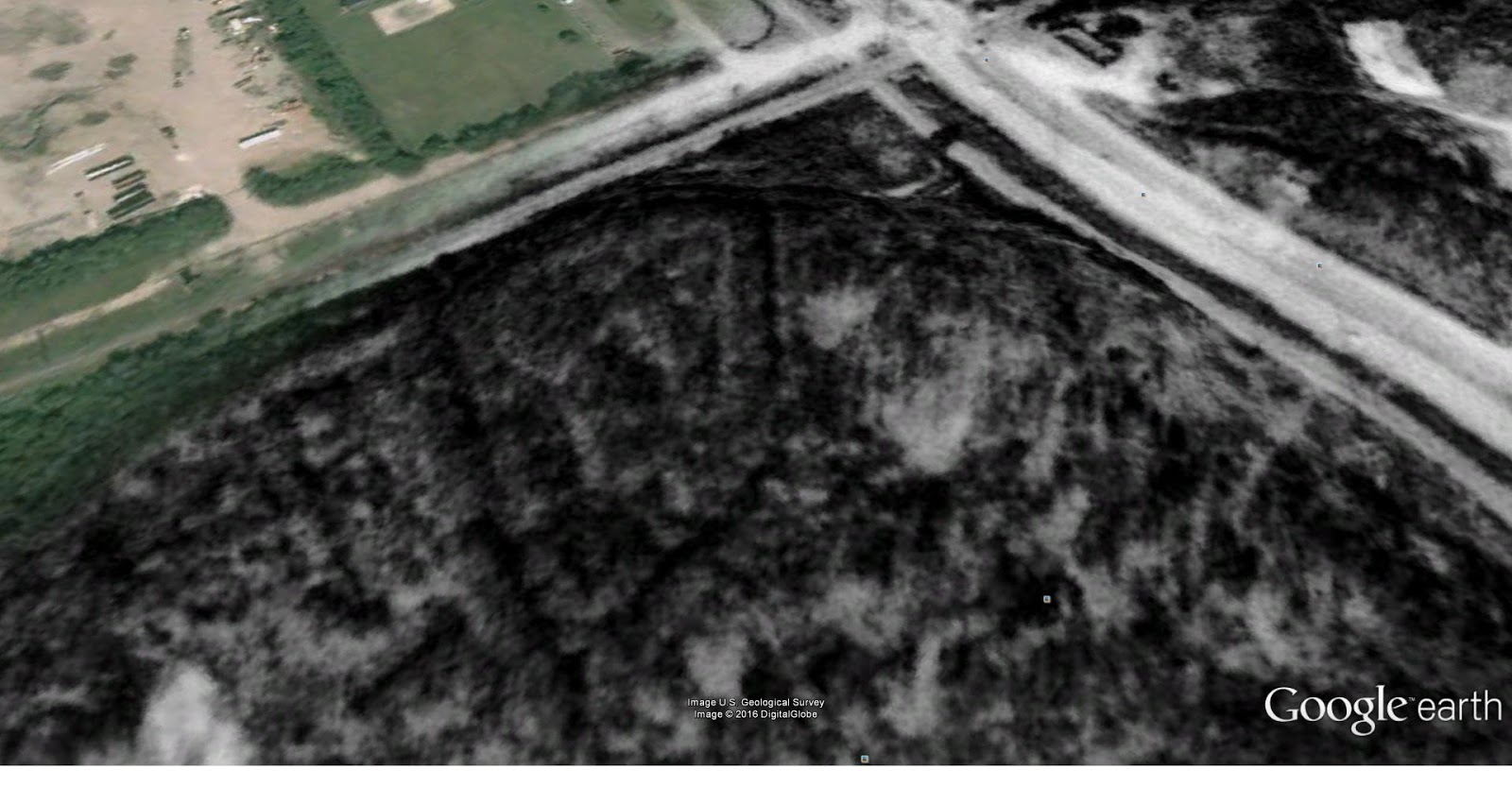
Amazingly, black and white Google Earth images from 1994 and 2003  show a clear view of the mound. It is an effigy,  like Serpent Mound, and possibly a depiction of the  Maya moon and rain goddess, as shown on America Unearthed Season 1 Episode 1..
The fact that the mound has a shape that is visible from the sky, similar to the Nazca figures and Serpent Mound, has gone unnoted despite being in the middle of Georgia's first capital city, likely because all of the mounds are covered with trees. 
Since 2004 Google Earth has had color versions of this area, and apparently only during winter when the foliage is full..
The 1994 and 2003 images, however, are black and white.  They show the shapes of the mounds clearly, likely because the flooded areas show up much darker. It's also possible that Google Earth filmed during winter in those years when foliage was thinnest. From 2004 to 2014, some archived versions are better than others depending on what part of the year the satellite photo was taken..
The low areas between the concentric rings of the mound are filled with water, and according to historic accounts have been since their discovery. 
We took a walk around the outer rings today and confirmed their shapes. 
Since there was no Google Earth when archeologists noted the site and dug tests pits in the 1800s and early 1900s, they would not have been aware of the  shape of the mound.
The last time an archeologist visited the site was in 1957. From Thornton's article:

"In 1957,  archaeologist William Haag from Louisiana State University became interested in the Bilbo artifacts after Humble Oil Exploration Company  began drilling a test hole near the archaeological site in search of petroleum.   He dug some test pits to determine the chronology of the artifacts unearthed by Caldwell.  There was no pottery below a level dated at 1,870 BC.   Halfway down to the base from there was dated at 2,165 BC.  The base of the mound was dated at 3,540 BC."

This would be about the time of Oppenheimer and Manansala's Nusantao diffusion:

 "Now at about this same time (pre-5000 BC), we see shell mounds popping up at Ubaid sites in the Persian Gulf. Oppenheimer has noted that the Ubaid sites contain pretty much the same inventory as those in the SE Asian Neolithic -- quadrangular stone adzes, stone hoes, clay sinkers and spindle whorls, beads, discs and painted pottery." Source: Quests of the Dragon and Bird Clan

Elsewhere, Manansala adds the practice of cranial deformation to the list of Nusantao trademarks. This is a practice shared by the Maya and recently found in Native Americans in Georgia, also shown on the debut America Unearthed from 2012.
My own contribution to this list will be Y Haplogroup T and microcephalin D, but that's another story....

The image of the rain goddess is one of the many items that Richard Thornton and others have used to link the Maya to tribes of the southeast and/or the Creek Alliance and the Uchi.
To his list, I would like to add "Haint Blue," a paint used by the Gullah people in the Savannah area.  The ingredients of this sacred pigment have  been kept secret, but Savannahian's have long suspected indigo from local plantlife to be a key ingredient, and I have a strong suspicion that it  also contains palygorskite, just like Maya Blue.
It's pretty much accepted nowadays that Mexico imported its palygorskite for Maya Blue from Georgia.

Here is the link to Richard Thornton's original article that sparked the investigation:


Post Script:
Thornton noted in his article that the series of mounds of which Bilbo Mound is a part is also significant for being the location of the first game of golf ever played in North America.

Interestingly, Bilbo Baggins's ancestor Bullroarer Took invented the game of golf by lopping the goblin-king's head off and sending it to roll across the field of battle and down a rabbit hole.
Bullroarer Took was a tall hobbit, and the only hobbit ever to have been known to seat a horse.
The Bilbo Mound, however, was named after a type of sword.



Share/Bookmark

Friday, February 12, 2016

Discussing Ancient Giants Remains on the Jason Colavito Blog


I want to commend Jason on his work to expose the hoaxsters, but I have also found some serious errors in his overall perspective on this topic. Moreover, I find the majority of the comments on this page to be woefully ignorant of historic fact, which is as bad a travesty as the disinformation spread by pseudoscientists. . Here's why, using quotes from valid publications as they appeared on February 12th of 2016:


Share/Bookmark

Thursday, January 21, 2016

Evidence of a prehistoric massacre extends the history of warfare

The fossilised bones of a group of prehistoric hunter-gatherers who were massacred around 10,000 years ago have been unearthed 30km west of Lake Turkana, Kenya, at a place called Nataruk.
Researchers from Cambridge University's Leverhulme Centre for Human Evolutionary Studies found the partial remains of 27 individuals, including at least eight women and six children.
Twelve skeletons were in a relatively complete state, and ten of these showed clear signs of a violent death: including extreme blunt-force trauma to crania and cheekbones, broken hands, knees and ribs, arrow lesions to the neck, and stone projectile tips lodged in the skull and thorax of two men.
Several of the skeletons were found face down; most had severe cranial fractures. Among the in situ skeletons, at least five showed "sharp-force trauma," some suggestive of arrow wounds. Four were discovered in a position indicating their hands had probably been bound, including a woman in the last stages of pregnancy. Fetal bones were uncovered.
The bodies were not buried. Some had fallen into a lagoon that has long since dried; the bones preserved in sediment.
The findings suggest these hunter-gatherers, perhaps members of an extended family, were attacked and killed by a rival group of prehistoric foragers. Researchers believe it is the earliest scientifically-dated historical evidence of human conflict -- an ancient precursor to what we call warfare.....Click for More

Share/Bookmark

Friday, January 15, 2016

Mysterious 'Hobbit' Relative May Have Lived on Isolated Island

A mysterious relative of the extinct human species nicknamed the "hobbit" may have once lived on the Indonesian island of Sulawesi, new study suggests.
This finding could one day help shed light on the evolution of the hobbit, the researchers noted in the study.
In 2003, scientists unearthed 18,000-year-old fossils on the Indonesian island of Flores. The fossils belonged to an unknown hominin, a close relative of modern humans. Since then, scientists have suggested that this hominin, which had a brain about the size of a grapefruit, was a unique branch of the human lineage named Homo floresiensis and popularly known as "the hobbit" because of its diminutive 3-foot (1 meter) stature. [See Images of the 'Hobbit' and Evidence of Newfound Ancestors...


...The scientists detailed their findings in the Jan. 14 issue of the journal Nature.

Article provided by John J. McNulty

Share/Bookmark